How to get your DHA healthcare licence in Dubai in 2026: 11 proven steps to success
How to get your DHA healthcare licence in Dubai in 2026: 11 proven steps to success
From trade-name reservation to malpractice cover, follow this DHA-approved roadmap for clinics, polyclinics, tele-health hubs and day-surgery centres.
Vincy Amirtharaj
58 post
Senior Business Setup Consultant, Dubai
Dubai is growing as a top destination for medical tourism in UAE. The healthcare sector here is expected to contribute around 5.1% of GDP by 2029 as several projects with potential are coming up in medical tourism, AI diagnostics and mandatory insurance coverage. Whether you are researching about the DHA license Dubai cost 2025 or just trying to figure out how to open a health facility in Dubai step by step, this blog contains every detail you should know. It also covers new rules, fees and shortcuts in a single action plan.
The same 11 milestones apply whether you are starting a telehealth startup in Dubai Silicon Oasis, a boutique dental practice on Jumeirah Road or a day-surgery center within DHCC Phase 2. These include trade-name reservation, Unified PQR approvals, Municipality fit-out, Civil Defence NOC, malpractice insurance, practitioner visas and corporate bank KYC. Here we have also demonstrated the right procedure to check all the boxes in the right order and save time on paperwork while keeping the budget of your healthcare business setup on track.
Below paragraphs were updated for 2025 based on the Sheryan portal, the DHIC e-ClaimLink mandate for insurance claims, AI triage sandboxes and the 9% corporate-tax regime. The checklist given here will help you avoid the three most common rejections. These include incorrect speciality code, missing infection-control plan and outdated CME certificates. Taking care of these steps will help your transition from the initial approval to a full healthcare licence in Dubai within 12 days for free zones and around four weeks on the mainland.
Typical 6-week licence-grant timeline
Week
Authority / Task
Key output
1
DET / Sheryan
Initial approval ✓ | Trade-name cert ✓
2
Dubai Municipality
Clinic layout drawings approved
3
Dubai Civil Defence
Fire-safety NOC issued
4
DHA
Healthcare licence issued ✓
5
MOHAP
Controlled-drug import permit (if applicable)
6
Insurer / eClaims
Malpractice & eClaims login – Go live!
Note: Free-zone packages at DHCC Phase 2 can cut Weeks 1-4 to 7–10 days;
MOHAP permits can extend Week 5 for radiology centres handling isotopes.
"The UAE and Dubai have placed a high priority on creating one of the world’s best healthcare sectors, in line with our development vision centred on human wellbeing and happiness." - His Highness Sheikh Mohammed bin Rashid Al Maktoum
Follow this 11-step checklist to complete your
healthcare-licence process in Dubai.
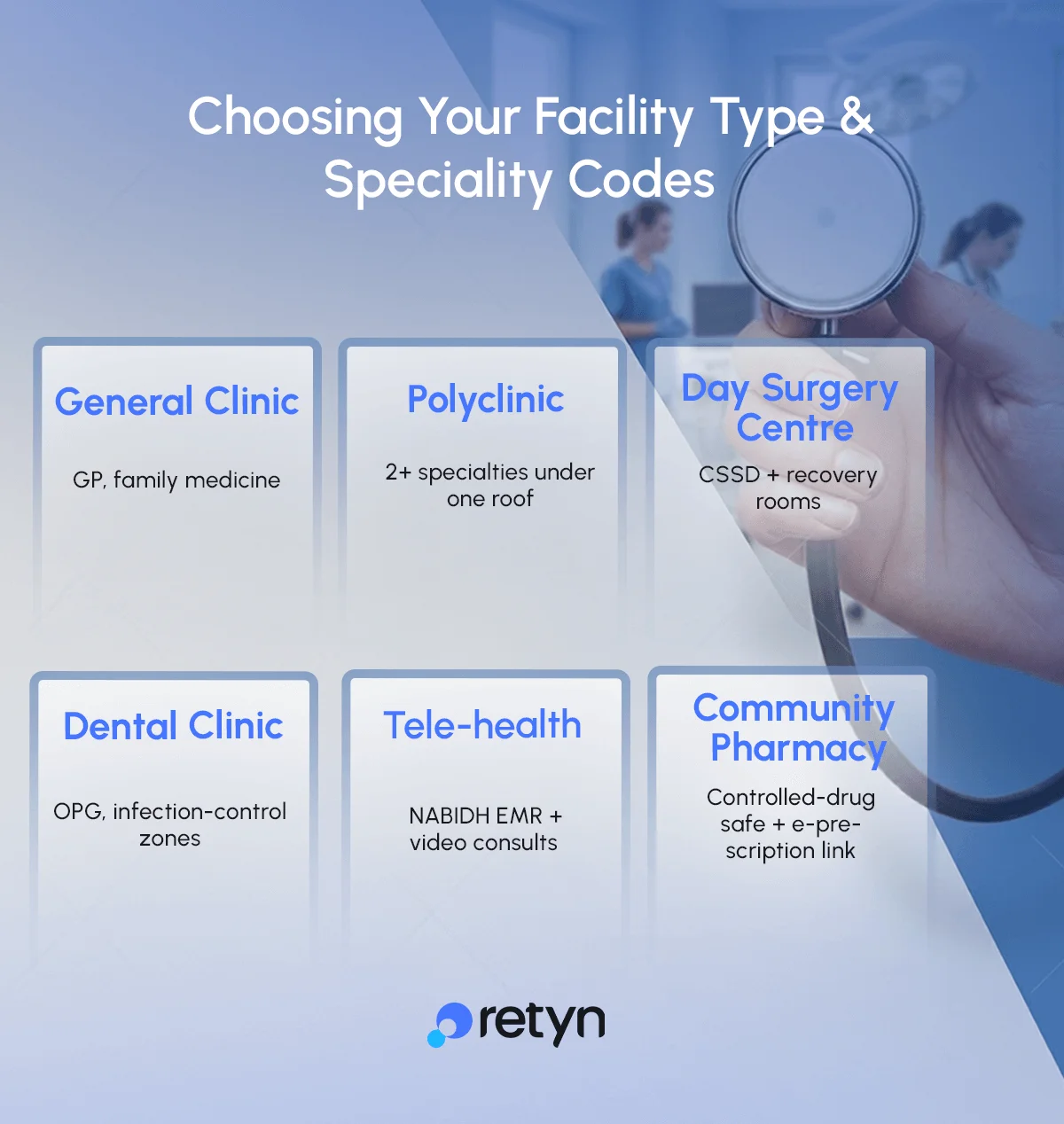
Step 1: Confirm your facility type & speciality codes
Match your planned services to the official DHA facility categories:
Choose a healthcare-friendly name (avoid “hospital” or “university” unless eligible) and reserve it via DET e-Services or your free-zone portal. Secure the matching domain & branded email—insurers reject generic addresses.
Quick Fact
For the 2025 fiscal year, the UAE allocated AED 5.745 billion, equivalent to 8% of the federal budget, to healthcare and community prevention services, reflecting its sustained commitment to developing the health sector.
Source: Dubai Health Authority
Step 3: Draft a compliance-ready business plan
A strong business plan is essential when you prepare to set up your business in Dubai, especially in the highly regulated healthcare sector.
NABIDH-compliant EMR, e-Claims API, AI triage chat-bot roadmap.
Pro tip
Attach your infection-control manual and medical-waste management agreement. Missing these two documents often causes delays.
Licence cost snapshot · 2025
DHA initial approval: ~AED 120
Trade-name reservation: AED 620
Mainland clinic licence fee: AED 18 000 – 25 000
DHCC free-zone package: from AED 16 000 (0-visa)
Malpractice insurance: from AED 6 000 / year
*The AED 50 000 bank-guarantee once required for polyclinics was abolished in 2024.
Licence-cost estimator (AED)
Estimated setup cost: —
Get detailed breakdown on WhatsApp
Includes AED 740 for initial approval (120) + trade-name reservation (620).
Fit-out, equipment & malpractice premiums vary—contact us for an exact quote.
Step 4: Select the right business structure
Your structure drives which authority issues the licence, visa quotas, and insurer panel acceptance:
LLC (Mainland)
Direct UAE patient services under a DHA facility licence.
Sole establishment
Ideal for solo GPs or dietitians—lower fees, but personal liability.
Free-zone FZ-LLC / FZE
100 % foreign ownership; licence issued by zone authority (e.g. DHCC).
Branch office
Let an overseas hospital brand operate under its parent balance sheet; quicker insurer credentialing.
Pro tip
DHA now issues digital facility licences; each speciality code (e.g., dentistry vs radiology) still needs a separate room inspection.
Curious about the actual costs and timeline for starting a healthcare facility in Dubai?
We’ve compiled a resource page with a transparent cost calculator, the main advantages of a structured setup process and the core services we offer.
Serve residents & tourists directly, access all insurer networks, and bid for government tenders. Requires DHA facility licence, Municipality fit-out permit, and Civil-Defence NOC.
The human health and social work activities sector recorded the highest growth, expanding 20 percent and contributing 1.4 percent to Dubai’s GDP in H1 2025.
Source: Dubai Data and Statistics Establishment
Step 6: Apply and obtain your healthcare licence
Submit the online forms, upload PQR files, and secure Municipality & Civil-Defence endorsements.
Create your establishment card in the GDRFA portal, register for WPS payroll, and issue investor visas. Doctors and nurses need individual DHA professional licences plus annual CME/CPD points.
Pro tip
The DHA mandates the management and submission of CPD activities for license renewal via the Sheryan portal. Practitioners must fulfill the minimum required annual CPD hours (e.g., 40 points for physicians and dentists, 20 points for nurses)
Need help understanding the process?
Schedule a free consultation to walk through your questions and explore the most suitable pathway for your healthcare setup in Dubai.
Provide your new DHA facility licence, fit-out completion certificate, projected cash-flow, and AML policy. A live website with domain email accelerates KYC.
Trade licence
Final DHA / free-zone document.
Cash-flow forecast
12-month patient-volume & expense projection.
Insurer MOUs
Letters of intent from medical insurers or TPAs.
Website & email
Active corporate domains and avoid generic emails.
Tip: If any shareholder holds a “high-risk” passport, add a source-of-funds letter and last 6 months’ bank statements to cut compliance queries.
Step 9: Secure external approvals & codes
Beyond DHA / free-zone, you may need:
Radiation-protection licence (FANR)
For X-ray or CT rooms; lead-shielding report required.
MOHAP controlled-drug permit
Class IV narcotics or isotopes for oncology.
Dubai Blood Bank NOC
For day-surgery units storing blood products.
Offering tele-pharmacy? DHA’s Telehealth Standards prohibit the prescribing of narcotic, controlled, or semi-controlled medications through tele-pharmacy services.
Step 10: Arrange insurance & liability cover
Maintain malpractice cover (clinic & individual), public liability, equipment-breakdown insurance, and staff medical insurance. No bank guarantee is required.
Expert insight: 3 growth levers for healthcare entrepreneurs in 2025
1. Outcome-based contracts are replacing fee-for-service
A visible shift is witnessed in the UAE's healthcare market from a traditional Fee-for-Service model to Outcome-Based Contracts (VBC).
Insurers favor clinics that can track and report patient outcomes like HbA1c, readmissions and vaccinations. Clinics with efficient and data-ready systems can further increase the speed of their network credentialing timelines.
Clinics that meet targets often attract performance-based payments and bonus pools soon after the VBC system launch.
Major insurers will consider your clinic as a valuable partner if you obtain an EMR data connection to payer dashboards and build an internal outcomes analysis function (like hiring a part-time analyst).
Actionable steps
Try submitting a detailed outcomes dashboard during the network onboarding to show your commitment and quality standards. It encourages payers to reduce the initial probation period.
2. Data interoperable clinics sell for higher multiples
Healthcare facilities with easily shareable patient data system can secure higher valuations. Private equity groups and large health systems are ready to pay for clinics with tech facilities.
Systems based on modern standards like FHIR APIs and HL7 feeds align with national health information initiatives like the UAE’s Malaffi and NABIDH that reduce integration risks for potential buyers.
Building an API-first stack in the early stage itself lowers future integration costs when new sites are added or when an exit is planned.
Actionable steps
Choose FHIR-native EMR vendors from the beginning to make sure of maximum interoperability that reduces the later expensive migration.
Adding a public sandbox endpoint to your system enable third parties (like pharmacies and labs) to connect and exchange data without installing any custom integration hardware.
3. AI capacity planning doubles chair utilization
Predictive analytics done with AI forecasts no-shows and patient flow with accuracy. It allows smart overbooking and mixing walk-ins with remote follow-ups.
Revenue for each asset increase when utilization rates stand high. AI can reduce the time limit needed to recover your clinic’s build-out and equipment investment (fit-out CAPEX) by increasing throughput.
Actionable steps
AI tools are used to predict no-shows and safely overbook low-risk time slots. Connect the patient-volume forecast of AI to your payroll system (WPS). Then, you will be able to change the shift from fixed staffing schedules to demand-based schedules.
Pro tip
Add a KPI slide on outcome bonuses, API readiness & AI utilisation gains to your pitch deck—investors now rank digital-maturity metrics above bed count.
Decision snapshot – what to choose, at a glance
Structure / Licence
100 % foreign ownership
On-shore patient care*
Setup speed
Bank-account ease**
Fit-out rule
Mainland LLC (Clinic licence)
Yes
✓ (direct)
≈ 4 weeks
★★★★★
Municipality permit + DCD NOC
DHCC Free-zone FZ-LLC
Yes
▲ needs DHA affiliation
3-10 days
★★★★☆
Zone fit-out standards
IFZA Tele-health FZE
Yes
▲ tele only
5-8 days
★★★☆☆
Virtual hub / flexi-desk
Sole establishment (Dietitian)
Yes
—
≈ 3 weeks
★★★★☆
Shared office zone
Day Surgery Centre (Mainland)
Yes
✓ (direct)
≈ 6 weeks
★★★★★
OR & CSSD approvals
* “On-shore patient care” = treating patients physically inside the UAE.
** “Bank-account ease” reflects typical KYC scrutiny: mainland trade history helps; brand-new free-zone firms may need extra proof of funds.
Schedule these annual tasks to keep your licence active and avoid fines:
Compliance often gets overlooked when starting a business in Dubai, but for healthcare facilities it is essential for maintaining good standing with DHA.
Facility-licence renewal
DHA / free-zone payment & paperwork every 12 months.
Malpractice & public liability
Renew policies; submit updated certificate to DHA.
CPD points
Doctors & nurses need 40-20 CPD points required for License Validity (1 Year).
Corporate Tax
Corporate tax applies if your taxable income exceeds AED 375,000.
Create a shared compliance calendar for licence, radiation, CME and VAT deadlines—inspectors often ask for evidence of tracking.
Risk & penalty matrix (DHCC) – key non-compliance fines
Offence
Applicability
Fine (AED)
Illegally employing persons who are not sponsored or approved by DHCA
Licensee
50,000
Failure to adhere to decisions issued by DHCA
HCO/HCP
10,000
Unauthorized storage of narcotic drugs
HCO
40,000
Figures are based on DHA, Dubai Municipality & MOHAP schedules published Q3-2025.
Always check latest circulars before budgeting.
Selecting a speciality code that doesn’t match services—DHA will reject the licence.
Sourcing equipment before fit-out approval—risk of costly relocation.
Under-budgeting malpractice insurance for surgeons & anaesthetists.
Running X-ray rooms without a radiation licence—AED 2 000 fine + shutdown.
Using a PO-box only—DHA & banks require a physical address.
Regulation & News updates · 2025
UAE launches licence transfer for healthcare professionals – 10 Aug 2025:
Healthcare workers can transfer licences between DHA and DoH-Abu Dhabi without reassessment, cutting steps, documents and approval times.
MoHAP cuts service steps by 50% – 4 Aug 2025:
MoHAP has simplified many healthcare services, cutting steps and documents to make licensing and approvals faster and easier under new Zero Bureaucracy roadmap.
DoH issues revised Medical Waste Management Standard – Sep 2025:
Medical-waste rules updated for all licensed healthcare providers with tighter storage, transport, treatment and record-keeping requirements.
UAE Health Ministry launches digital fines collection system – 16 Jun 2025:
MoHAP adopts a new digital platform to monitor and collect fines, automating workflows and offering multiple online payment options.
DHA deploys AI-powered privacy system to protect patient data – 27 Apr 2025:
DHA integrates AI-driven Privacy Intelligence into NABIDH to detect unauthorised access, strengthen data security and improve compliance.
UAE launches unified national platform for health-professional licensing – 1 Feb 2025:
MoHAP rolls out a single digital licensing system for doctors, nurses and allied health staff, reducing approval times across all emirates.
MoHAP deploys AI system to auto-check healthcare facility designs – 29 Jan 2025:
New AI system reviews medical centre blueprints, detects design violations and accelerates licensing approvals with more compliance checks.
Glossary of acronyms
DHA – Dubai Health Authority
DHCC – Dubai Healthcare City
EMR – Electronic Medical Record
CME – Continuing Medical Education
FANR – Federal Authority for Nuclear Regulation
PQR – Professional Qualification Requirements
CT – Corporate Tax (9 %)
FAQs on securing a healthcare licence in Dubai
Fit-out costs of clinics can be different based on the building's condition and level of clinical complexity. Many contractors quote around AED 2,000 to 3,000 per m² for standard GP or dental rooms. Areas designed for procedures or day-surgery usually are more expensive because they require specialized HVAC, cleanroom finishes and additional safety systems.
An increase in cost can be expected if Dubai Municipality or Civil Defence suggest changes after their inspections. Because of this most of the clinics set aside a contingency buffer in their budget.
Yes. Clinics usually receive initial approval within 5 working days under DHA “New Healthcare Facility License” service, if all the needed documents are complete.
This initial approval does not give operational authorization for the clinic. Licence is activated later after inspections and final compliance checks.
Required documents
Floor plan prepared by a licensed engineering or design company
Trade license ( which is optional at this stage)
Proposal letter or business plan
An extra AED 3 000–5 000 facilitation fee applies but can shave three weeks off the timeline.
Rejections happen because of the following reasons.
Wrong speciality code (like listing radiology without a lead-lined room)
Missing infection-control plan (CSSD workflow diagram)
DataFlow pending or negative verification results for a key practitioner
Expired CME certificates in the PQR upload
Hiring process usually depends on the fastness with which a candidate completes DataFlow Primary Source Verification (PSV). PSV can be completed in a few weeks to just over a month.
Onboarding delays can be prevented by starting early DataFlow, even before the finalisation of your facility fit-out or lease. Once PSV is done and the facility licence is activated, steps like DHA professional licensing and visa processing happen easily.
Corporate Tax: Clinic profits usually fall under the 0% or 9% Corporate Tax rules. It is applicable unless the clinic qualifies for certain reliefs like Small Business Relief or QFZP status.
VAT: Direct patient care falls under the Zero-Rated (0%) VAT category rather than being an exempt. This enables the clinics to recover VAT on their expenses.
TPAs offer interim credentials in 14 days if you submit all the needed documents here.
Readiness form for DHA e-Claims
12-month outcomes KPI sheet ( like vaccination and readmissions)
Payer-specific tariff discounts (5 to 10%) for the first six months
Most TPAs grant interim credentials within 14 days if these documents
accompany the application.
Recent transactions show:
General clinics: 5.2–6.0× EBITDA
Dentistry chains: 6.5–7.5× if chair utilisation >75 %
AI-enabled tele-health platforms: 8–9× with >60 % recurring revenue
Interoperable EMR APIs and value-based payer contracts add 1–1.5×
on top of headline multiples.
Disclaimer: This content is for information only and not legal advice. Regulations change—always consult a qualified professional.
Need help getting your healthcare licence approved?
Book a free consultation with our team for step-by-step guidance.